Hi. I bought 2 sensors of yours. Do these sensors have same rate of rise when same force is applied to each sensor? Would you tell me the margin of error(error factor)?
 JaneYu 2018-05-20 11:08:03 7 Views59 Replies
 Hi. I bought 2 sensors of yours. Do these sensors have same rate of rise when same force is applied to each sensor? Would you tell me the margin of error(error factor)?
Hello, I have a question, I would like to know if the system has a preset error percentage.
JaneYu Unfortunately we do not have this parameter. This sensor simply amplifies the electrical ** signals.
If i buy this sensor and i connect to arduino and on arduino i upload normal analog read code that reads from analog and print to serial so without installing the library of the sensor and without using the code that the sensor came with, will this work? please reply
JaneYu In this case the value displayed by your serial monitor will fluctuate considerably. Our EMG sensor library acts as a filter.
Hi there, I have recently bought Gravity EMG sensor . But when I connect sensor with Arduino and electrode on biceps **, I acquire signals like figure below instead of tutorial video. Can anyone tell me what is problem and how to fix that? https://uploads.disquscdn.c...
JaneYu You can adjust the position of the electrodes slightly with the electrodes fitted and also see if there is any change in the data.
Try to adjust the wear tighter, the skin may be drier in winter.
Please test it on your small arm, just like our example picture.
Yes, this will work, but we don't have sample code for this for your reference. Because this will involve some algorithms.
JaneYu Sorry for the delayed response due to the Chinese New Year Festival.
Can you put which controller you are using?
Also send us a picture of your connection and the values printed by the serial monitor.
Also, the output values of this EMG sensor vary from person to person. We recommend that you place the electrodes on the inside of your arm where there are more muscles.
In our actual tests, attaching to a less muscular area may result in less variation in the EMG sensor's numerical output.
JaneYu Does this sensor work with raspberry pi? if my raspberry pi has adc hat, meaning it has analog pins. And is there sample python code for it? Thanks!
JaneYu This is an analogue voltage output. And the Raspberry Pi doesn't have an analogue voltage interface, so the Raspberry Pi needs to access this sensor with the help of an external ADC.
But sorry, we don't have an example about the external ADC.
Hi, I am testing the sensor with LPF, HPF and norch, I have the same confusion, when you choose the cutoff frequency as 150Hz for the LPF. I also used a moving average filter to further mitigate the noise and transfer to envelop, but initially there is lots of noise when I connect the port. After few secs, the noise disappear, do you know why there is some initials noise?
JaneYu Hi, It's impossible to install the EMGFilters Library, not even as a zip file, since it's not recognized by the Arduino IDE. Could you please upload it again?
JaneYu This is normal, and the normal way an EMG sensor is used is to subtract this reference voltage from the voltage change produced by the **.
For detailed use, you can refer to our wiki tutorial.
JaneYu Hello I purchased multiple of these sensors, is there a way to connect them in series to only one pin on the Arduino (I2C) or do I have to connect every single sensor to one pin? And is there a solution for the high values ? I receive values in the 1.000.000 + area....on my biceps.
JaneYu Library can't be install in latest arduino IDE
JaneYu Hi, Try manually adding the downloaded folder directly to libraries.
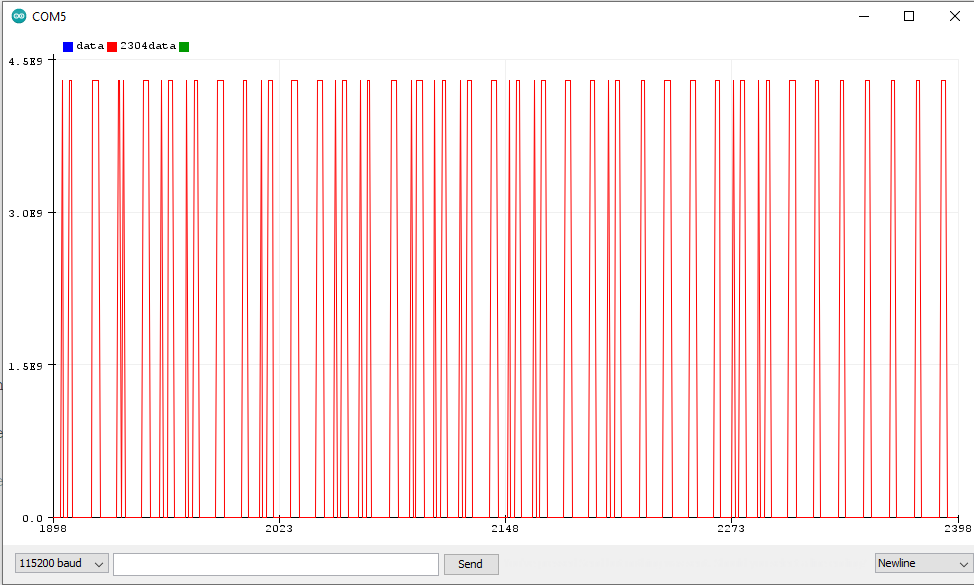
Hi, I have purchased the sensor. The sensor sometimes give a reading of 4E9. I have followed all the instructions. Can anyone help me out please?
JaneYu Hi, the sensor acquires ** electrical signals, and due to the large size of the module, it is not recommended to wear it on the finger
JaneYu Hello, where can I get the 3D model of the Signal Transmitter Board? I want to put it on top of a PCB and I need the location of the screw holes. And which screws does it use?
JaneYu Sorry we don’t have a size file, the positioning hole on this module has a diameter of 3mm
Hi all,
While all is working, I need more data from my sensors. To do so, I want to use your EMGFilter library, however, EMG signal are active between 5 and 450 Hz. So I feel that your 20 and 150 Hz cutoff frequencies are trimming too much of the signal.
Could you please tell me what the coefficients would be for my proposed cut-off frequencies? I am aware that with such request, I will have to use the 1000Hz sampling frequency and won't use the 500Hz one.
In short, how do I adapt the following lines to 450Hz LPF and 5Hz HPF ?
// coefficients of transfer function of LPF
// coef[sampleFreqInd][order]
static float lpf_numerator_coef[2][3] = {{0.3913, 0.7827, 0.3913},
                                         {0.1311, 0.2622, 0.1311}};
static float lpf_denominator_coef[2][3] = {{1.0000, 0.3695, 0.1958},
                                           {1.0000, -0.7478, 0.2722}};
// coefficients of transfer function of HPF
static float hpf_numerator_coef[2][3] = {{0.8371, -1.6742, 0.8371},
                                         {0.9150, -1.8299, 0.9150}};
static float hpf_denominator_coef[2][3] = {{1.0000, -1.6475, 0.7009},
                                           {1.0000, -1.8227, 0.8372}};
Thanks in advance for your help !
JaneYu Hey DFRobot, i found the issue.
The problem is not with the code or calibration but in the humidity of the skin.
I think that will be nice to mention that in the wiki.
also maybe you can find some some solutions (like a gel or some liquid or mabe the shape of the PCB) to improve the connection between the skin and the sensor.
I hope that this comment will help other people that have this issue because i found a large nr. of users with this exact problem.
JaneYu i tried the sketch that says to set the treshold to zero and find the maximun value when relaxed bu with that the value is always high and is not changing
JaneYu