
What is, more or less, the minimum height of water it detects?Does 0.5% of accuracy mean it has ~0.025m (2.5cm) of accuracy?Thank you!
 JaneYu 2019-06-05 05:19:40 14 Views26 Replies
 What is, more or less, the minimum height of water it detects?
Does 0.5% of accuracy mean it has ~0.025m (2.5cm) of accuracy?
Thank you!
@dfr robot support
Hello, I want to put an external power supply (24 VDC/1A) to power the probe, I will need to know what the maximum intensity of the analog converter is because the signal delivered by the probe will be 4-20mA, but that of the power supply in 1A.
JaneYu @dfr robot support
Hello , I bought your product and would like to know what the cable material is?
JaneYu The wire is made of polyurethane rubber.
If you need to put it into corrosive liquids, we believe that weak alkaline liquids are OK, but acidic liquids and strong alkaline liquids are not OK.
The sensor probe is capable of withstanding this pH range, but our metal probe is 304 stainless steel, so you may need to judge whether this type of material will be able to withstand corrosion in your wastewater.
JaneYu The sensor probe has a stainless steel ** that can be placed in water.
If your fuel is diesel, you can also put it in. Diesel generally does not have a corrosive effect on stainless steel.
JaneYu Hello, I have ordered this probe. I set up the setup exactly as in the example, unfortunately the probe shows me wrong values. According to the terminal, the probe is 2 meters under water, but it's on my table. I use it on an Ardino Leonardo, the probe has a 12 V power supply.
JaneYu Ultrasonic sensors cannot be used side by side at the same time, otherwise interference will occur. What is your specific measurement environment like?
JaneYu Tengo un problema con el sensor que al parecer se descalibró. Sin agua muestra 3,7mA; Con 1,5 metros de agua apenas sube a 5 mA. Que puede ser ??
JaneYu Please contact our technical support mailbox [email protected] and elaborate on your question, thank you.
hello,
please am working on my thesis project , I need help please if this sensor Gravity: Throw-in Type Liquid Level Transmitter need calibration ??
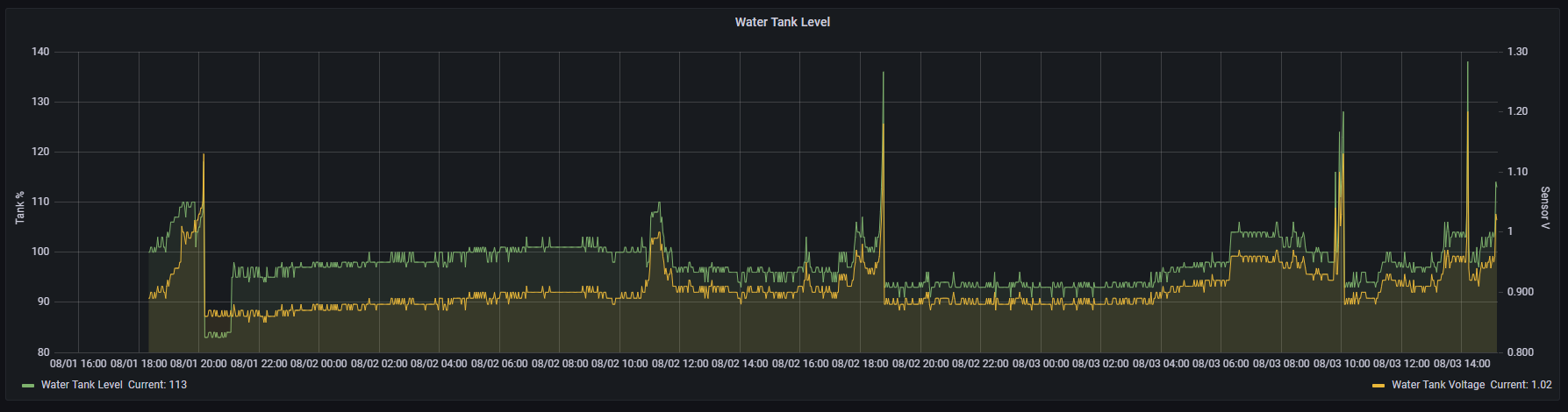
JaneYu I have a thrown in level sensor from dfrobot https://uploads.disquscdn.c... connected through a current to voltage converter and a node MCU. I get the random voltage spikes and voltage variations throughout when no water is being added or removed see below. Can someone please help? Could this be related to the tank heating up and the water inside as the sun hits the western side of the house in the afternoon. Because it is always in the afternoon around the same time. Is anyone else seeing this?
My voltage and level percentage calculation increases with temperature which is counter-intuitive I would have thought the hydrostatic pressure would decrease with increase in temperature as the density decreases or stay the same due to an equivalent increase in fluid height due to volume expansion in a fixed container volume. Note my tank is a vented non pressurised tank. Do you think my volume expansion and hence fluid height increase greater than any density reduction hence I am seeing an increase in level/hydrostatic pressure?
It says it has built in temperature compensation. Which makes me wonder if the temperature issue is related to the pressure sensor or the node mcu chip and power supply heating up with ambient temperature going up.
JaneYu I asked the same question over on the Home Assistant forums. One guy came back and said it uses power all the time. He was using a power over ethernet (POE) adapter to power the sensor. However that still does not answer the question of how much current draw it has, but I think it is safe to say running it on a battery is probably not feasible.
JaneYu Hi Frederick and Brian,
The maximum current consumption of the sensor is 30mA.
Hope that helps.
@dfrobot:disqus I'm wondering the same thing, I'd love a response to this question
JaneYu Sorry, this sensor measures rang just 0-5m. If you want to measure 200m, pls contact [email protected] to customize.
JaneYu Use consistent units in your code! dataCurrent = dataVoltage / 120.0 outputs A not mA. Your variables are defined in mA. dataCurrent = 1000.0*(dataVoltage/120.0) produces correct results.
JaneYu Hello, there is no problem with the data we tested, can you send us the data generated by the actual measurement and the physical connection diagram for confirmation? Thank you for your patience.
Hi, can this be used without the voltage converter module, directly as 4-20 mA signal input? Do we just replace the module by the current measuring device put in series across the + and - terminals right??
JaneYu Hi, can this be used without the voltage converter module, directly as 4-20 mA signal input? Do we just replace the module by the current measuring device put in series across the + and - terminals right?
JaneYu Could this sensor be used to detect changes in the density of a liquid when the depth/volume is unchanged, e.g. during a fermentation process?
JaneYu hello guys. Can this sensor be submerged in a corrosive liquid, with a pH between 4 to 8?
JaneYu 
 micro: Breadboard MBT0009