


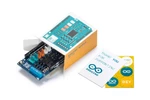
Arduino Motor Shield R3 (L298P Dual H-Bridge)
Introduction
Arduino Motor Shield based on the L298P dual full‑bridge driver enables reliable control of inductive loads including DC motors, relays, solenoids, and stepper motors. Designed as an expansion board for Arduino platforms, this motor control shield simplifies robotics and mechatronics development by integrating dual motor channels, direction control, and speed regulation through PWM signals. The robotics motor driver board also includes integrated current sensing for each channel, enabling monitoring of motor load during operation. TinkerKit compatibility further accelerates prototyping by allowing quick plug‑and‑play connection of modular sensors and actuators.
Dual H‑Bridge Motor Control Architecture
This L298P‑based motor driver expansion board supports simultaneous control of two DC motors or a single stepper motor using a robust dual full‑bridge architecture. Independent speed and direction management for each channel enables flexible drive systems for mobile robots, automated mechanisms, and motion prototypes. Integrated braking and free‑running stop functions improve control precision during acceleration or deceleration, supporting stable motor behavior in robotics experimentation and embedded motion control applications.
Integrated Current Monitoring Capability
Built‑in current sensing circuitry provides real‑time monitoring of motor load conditions at a ratio of 1.65V per ampere. This feature allows motor current measurement through analog inputs on the controller board, enabling protection strategies, performance analysis, and adaptive motor control algorithms. Such monitoring capability proves particularly useful for robotics developers building obstacle‑aware drive systems, motor stall detection logic, or energy‑efficient automation platforms.
TinkerKit‑Compatible Rapid Prototyping
TinkerKit connector compatibility enables seamless integration with modular sensors and actuators, significantly simplifying interactive hardware prototyping. This robotics motor control shield allows rapid construction of educational or experimental systems without complex wiring. Combined with common microcontroller development boards, the modular interface supports quick assembly of mechanical prototypes, automation experiments, and interactive STEM learning setups.
Suitable for robotics platforms, automated mechanisms, and educational motion control experiments, this dual‑channel motor driver board offers a practical foundation for motorized projects. The combination of H‑bridge control, current sensing feedback, and modular connectivity makes the shield a useful component for robotics development, embedded control experiments, and STEM Education projects involving DC or stepper motor actuation.
Features
- L298P dual full‑bridge motor driver architecture
- Drives 2 DC motors or 1 stepper motor
- Independent speed and direction control for two motors
- Integrated current sensing output (1.65V/A)
- Supports free‑running stop and electronic brake modes
- TinkerKit compatible connectors for modular prototyping
- Stackable shield design for Arduino development boards
Applications
- Two‑wheel or tracked mobile robot platforms
- Stepper motor motion control prototypes
- Automated mechanical systems
- Interactive STEM Education robotics projects
- Motor load monitoring and control experiments
Specification
- Operating Voltage: 5V to 12V
- Motor controller: L298P, Drives 2 DC motors or 1 stepper motor
- Max current: 2A per channel or 4A max (with external power supply)
- Current sensing: 1.65V/A
- Free running stop and brake function
Shipping List
- Arduino Motor Shield x1