


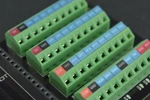

Terminal Block Board for Raspberry Pi Pico / Pico 2
- $19.40 3+ items
- $19.00 5+ items
- $18.40 10+ items
_144x96.jpg.webp)
_144x96.jpg.webp)


Introduction
Terminal Block Board for Raspberry Pi Pico / Pico 2 provides a convenient wiring solution for development setups that rely on screw terminals instead of jumper wires. Designed for rapid prototyping and reliable field connections, this Pico expansion board breaks out every GPIO pin into clearly labeled terminal blocks, simplifying circuit assembly and maintenance. Additional interfaces such as GDI display connectivity, dual 5V outputs, and a wide 7–24V external power input expand the usability of Raspberry Pi Pico–based systems. Clear silkscreen labels and visual port indicators further improve usability for embedded development, robotics integration, and classroom prototyping environments.

Figure: Board Overview
Full GPIO Breakout with Reliable Terminal Wiring
This Pico terminal expansion platform exposes all available GPIO pins through sturdy screw terminal connectors, enabling secure wiring for sensors, actuators, and external modules. Compared with jumper-wire connections, terminal blocks provide improved mechanical stability and reduce accidental disconnections during testing or deployment. Clear color-coded silkscreen labeling helps quickly identify each pin function, making this breakout solution especially useful for rapid hardware debugging, industrial prototyping setups, and projects that require frequent wiring changes.
Integrated Power Management and Flexible Voltage Input
An onboard power system accepts a wide 7–24V external input, simplifying integration with batteries, industrial power supplies, or robotics platforms. The board also provides dedicated 5V and 3.3V distribution terminals for peripherals and sensors. Such flexibility allows a Pico-based controller to operate reliably within embedded systems that require stable external power routing while maintaining organized wiring through terminal connectors.
Status LED Indicators with Switchable Control
Each terminal channel includes a blue LED indicator that visually displays port activity and power presence. This diagnostic feedback helps identify wiring errors and signal activity during debugging. A dedicated onboard switch allows disabling the indicator LEDs when low-power operation or reduced visual distraction becomes necessary. Such diagnostic indicators make this GPIO terminal breakout board particularly helpful during hardware troubleshooting and laboratory experimentation.

Figure: I2C Hardware Connection
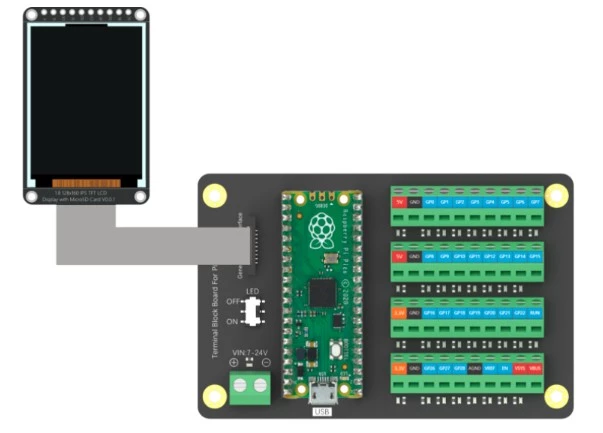
Figure: GDI Hardware Connection
This terminal block breakout solution supports structured wiring for embedded controllers, robotics control panels, and prototyping benches. The Pico expansion interface also simplifies integration of displays through the GDI connector and enables reliable external power routing. Such features make the board suitable for maker laboratories, engineering prototypes, and STEM Education hardware projects built around the Raspberry Pi Pico ecosystem.