


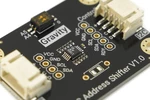

Gravity: LTC4316 I2C Address Shifter Module for I2C Conflict Resolution


Introduction
DFRobot LTC4316 I2C Address Shifter enables reliable operation of multiple identical I2C sensors on a single communication bus. Designed for Arduino, Raspberry Pi, and other development boards, this hardware-based address translation module modifies sensor addresses without altering firmware. By placing the address translation board between a host controller such as Uno R3 or Pi 4 and an I2C peripheral, duplicate sensors can coexist within the same system. A compact PCB layout, plug‑and‑play wiring, and configurable address mapping make this gravity‑series interface board well suited for scalable I2C sensor networks and modular electronics projects.
Plug-and-Play Hardware Address Translation
Unlike software multiplexing or firmware modifications, the LTC4316-based address translation board performs address conversion directly at the hardware level. This design allows identical I2C sensors to operate simultaneously while maintaining stable bus timing and communication reliability. No firmware adjustments or additional libraries are required on the host controller. Such hardware-level address shifting simplifies integration in embedded systems, robotics controllers, and IoT nodes where multiple sensors must share a single I2C interface without causing address conflicts.

Figure: Wiring Diagram of I2C Address Shifter, sensors and Arduino UNO
Flexible Address Configuration
This configurable I2C interface module provides four selectable address offsets through onboard DIP switches, enabling quick adjustments during development and testing. For advanced configurations, additional address combinations can be created by soldering external resistors, expanding the available address options beyond the basic switch settings. Such flexibility allows engineers and makers to deploy multiple identical I2C sensors within complex monitoring systems, environmental sensing arrays, or robotics perception platforms without replacing hardware components.
Compact Design for Modular Sensor Systems
A small 42×32 mm PCB footprint allows this gravity-series expansion board to integrate easily into compact electronics assemblies and stacked sensor systems. Standard connectors and gravity interface compatibility simplify wiring between microcontrollers and sensors while maintaining reliable signal routing. Such compact architecture makes the address shifting module suitable for embedded automation, educational electronics kits, and space‑constrained prototypes where efficient bus management and minimal hardware footprint remain essential.
Common deployment scenarios include multi‑sensor environmental monitoring, robotics sensing arrays, industrial data acquisition nodes, and educational electronics experiments. Within these applications, the address shifting board allows identical I2C peripherals—such as temperature sensors, light sensors, or distance modules—to coexist on the same bus while maintaining stable communication and simplified system architecture.