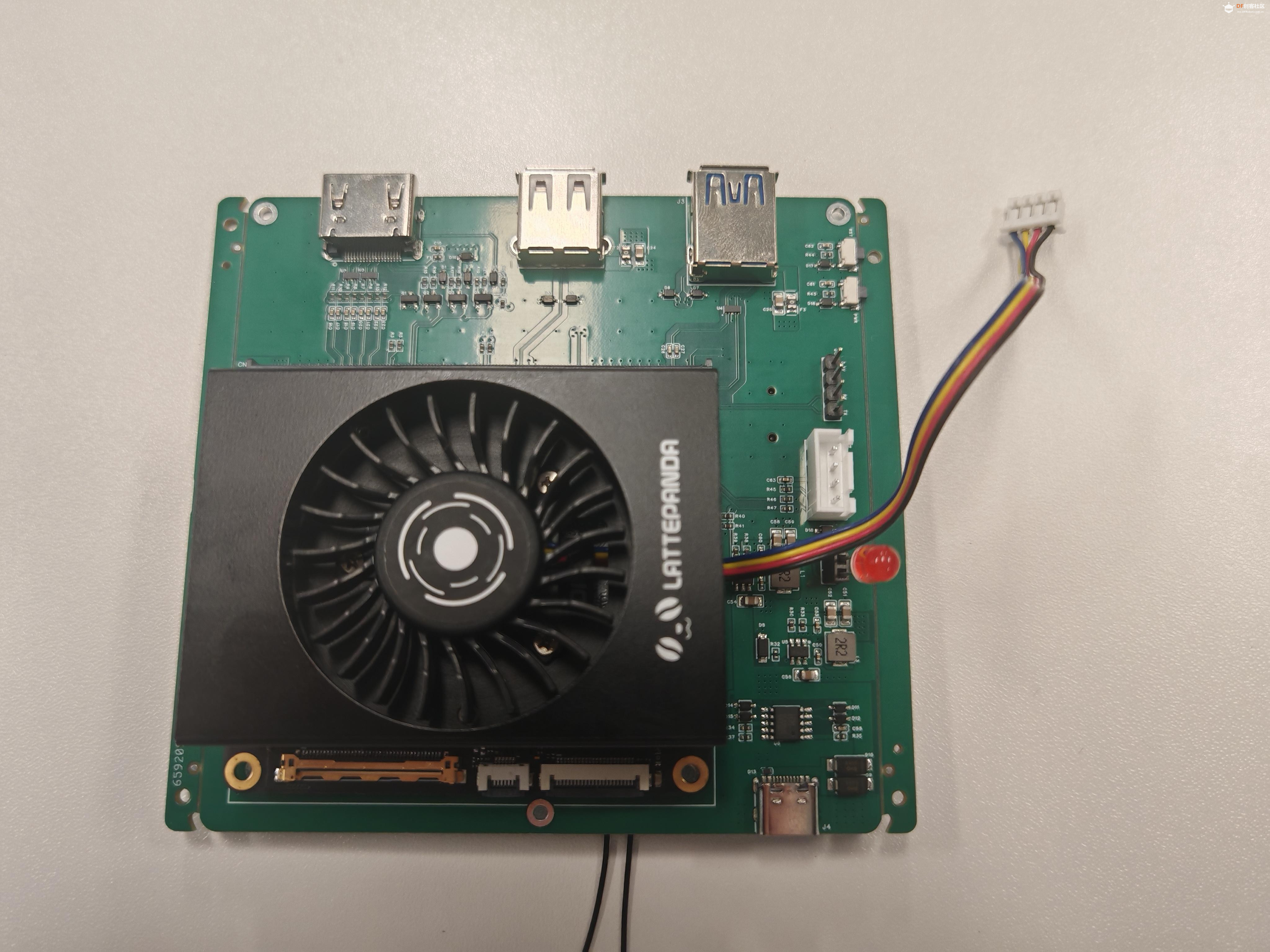
My first LattePanda Mu Minimal Carrier Board (From Schematic to First Boot)
 BigMC.Donald 2026-01-27 15:00:08 2038 Views2 Replies
 Project Overview
LattePanda MU is a tiny x86 compute module built around the Intel N100 quad-core processor, with 8GB LPDDR5 RAM and 64GB onboard storage. Despite the small size, it exposes plenty of I/O to play with — up to 3 HDMI/DP outputs, 8× USB 2.0, up to 4× USB 3.2, and up to 9 PCIe 3.0 lanes.
For this project, I recreated a mini carrier board using LattePanda’s official open-source reference designs. The board breaks out just the essentials: one USB 2.0, one USB 3.2, one HDMI output, plus an M.2 E-Key (2230) slot for expansion.
LattePanda’s documentation is solid and very complete, so this was mostly a “follow the reference, route the board, power it up” kind of build and the board booted successfully on the first try.
Schematic
The schematic is largely copied from the official LattePanda reference design. The main tweak here was swapping all components to JLCPCB-friendly parts, making it easier to move toward SMT assembly later on.


PCB
The PCB size is set to 100 × 100 mm, which not only makes routing more comfortable, but also conveniently qualifies for JLCPCB’s free prototyping size.
All components are selected from the JLC/LCSC library, making both SMT and 3D preview much more convenient.


Key Points
The real difficulty is the high-speed differential routing. Differential pairs must be length-matched, impedance-controlled, and routed with sufficient clearance to other signals in accordance with the 5W rule.
When USB 3.2 differential pairs need to transition through vias, grounded vias around the signal vias are recommended to reduce discontinuities. It is also critical to keep the reference ground plane continuous and avoid unnecessary plane splits under the differential pairs.


Bring-up Notes
The board passed bring-up on the first power-on (credit to the solid official reference docs). USB 2.0 and USB 3.2 throughput is on par with the official carrier board, with no noticeable degradation.
A 1080p display running at 60 Hz remained stable throughout testing — no dropped frames, no signal glitches, and no link instability observed.