


Arduino UNO R4 Minima Development Board


 Gravity: IO Expansion Shield for Arduino V7.1$4.90Details
 USB 3.0 to Type-C Cable$1.95Details
Introduction
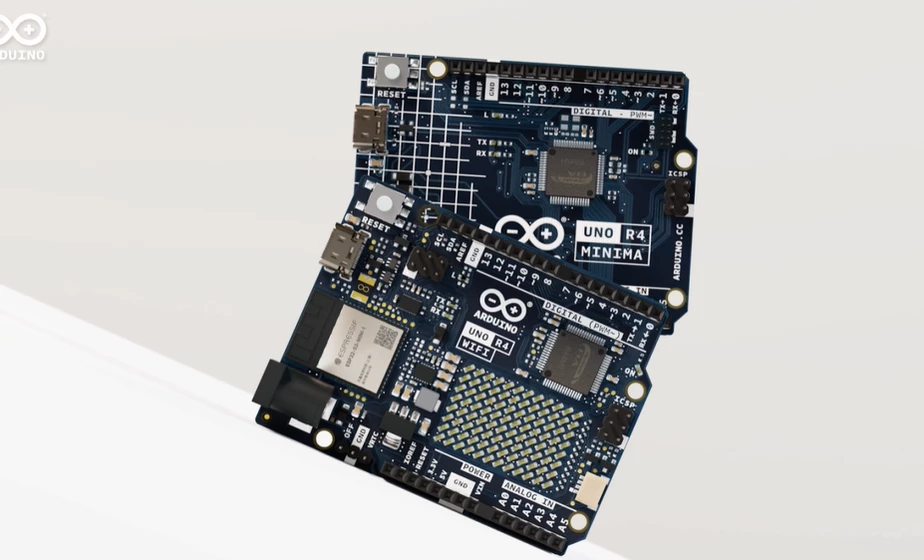
Arduino UNO R4 Minima Development Board represents the next evolution of the classic UNO platform, powered by the Renesas RA4M1 Arm Cortex®‑M4 microcontroller running at 48 MHz. Compared with earlier UNO generations, this modern microcontroller board delivers significantly higher performance, expanding SRAM from 2 KB to 32 KB and flash memory from 32 KB to 256 KB to support larger firmware and advanced applications. The upgraded platform also introduces USB‑C connectivity, integrated CAN bus capability, and a built‑in 12‑bit DAC. Maintaining the familiar UNO form factor and 5 V operating environment, this compact development board provides a smooth upgrade path for projects built within the Arduino ecosystem.
Significantly Enhanced Processing and Memory
A Renesas RA4M1 Arm Cortex‑M4 processor running at 48 MHz provides roughly three times the clock speed of earlier UNO platforms. Expanded memory resources—256 KB flash and 32 KB SRAM—allow more complex firmware, larger data buffers, and advanced algorithm implementation. This performance improvement enables demanding embedded applications such as real‑time control systems, data acquisition nodes, and communication gateways while preserving the simplicity associated with the UNO platform.
Integrated Advanced Peripherals for Expanded Capability
This next‑generation UNO controller board integrates several hardware peripherals rarely found in traditional entry‑level platforms. A built‑in 12‑bit DAC enables true analog signal generation, while integrated CAN bus support allows multi‑node communication with reduced wiring complexity. Additional on‑board resources including an operational amplifier and debugging access through an SWD connector provide expanded flexibility for embedded system development, industrial communication experiments, and precision signal projects.
Wide Voltage Support and Modern Connectivity
A wide input voltage range of 6–24 V simplifies power integration with motors, LED strips, and other higher‑voltage actuators using a single supply. USB‑C replaces the legacy USB connector, improving reliability and compatibility with modern hardware setups. HID functionality allows the microcontroller board to emulate keyboards or mice when connected to a computer, supporting creative human‑interface projects, automation scripts, and custom control devices.
UNO Form Factor Compatibility
Mechanical layout and pinout remain consistent with the classic UNO design, ensuring compatibility with the extensive ecosystem of existing shields and accessories. Standard 5 V logic levels maintain seamless integration with common sensors, drivers, and expansion modules. This hardware compatibility allows current prototypes and educational platforms to migrate toward a faster and more capable controller without redesigning surrounding electronics.
Such capabilities make this compact microcontroller platform well suited for embedded prototyping, robotics control systems, CAN‑based device networks, interactive HID projects, and educational experimentation. The combination of higher performance, expanded peripherals, and backward compatibility makes this development board a practical foundation for both learning environments and advanced maker builds.

Figure: Board Overview
Features
UNO R4 Minima maintains the same form factor, pinout, and 5 V operating voltage as the UNO R3, ensuring compatibility with a large ecosystem of UNO shields and accessories.
48 MHz processor speed combined with larger memory capacity enables precise calculations and supports complex embedded applications.
Integrated 12‑bit DAC, CAN BUS interface, and operational amplifier expand design flexibility and enable advanced signal and communication projects.
Input voltage range up to 24 V allows direct integration with motors, LED strips, and other higher‑voltage hardware using a single power supply.
SWD debugging interface enables external debugger connection for detailed firmware analysis and system monitoring.
Built‑in Human Interface Device functionality enables keyboard or mouse emulation through USB connection.
Applications
Specification
Shipping List
Documents
Resource


Review
Apr 30, 2026
good value, well packaged