


RS485 Modbus Water Quality pH Sensor (IP68)
- $125.00 3+ items
- $122.00 5+ items
- $119.00 10+ items



Introduction
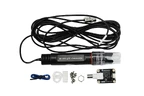
The RS485 Water Quality pH Sensor is an industrial-grade instrument engineered for continuous and precise water pH measurement. Featuring an integrated probe and housing design, the unit delivers a streamlined, robust solution for demanding environments. It accurately captures pH levels across a 0-14 range, offering a high resolution of 0.01 pH and an accuracy of ±0.15 pH.

Designed for seamless integration into IoT networks and automated systems, this pH sensor is equipped with an RS485 communication interface supporting the standard Modbus-RTU protocol. Comprehensive documentation and tutorials for Arduino development boards and DFRobot LoRaWAN are available, making it an exceptional arduino water ph sensor for rapidly deploying testing environments and real-time data monitoring systems. To guarantee consistent data output under fluctuating environmental conditions, the sensor features a built-in temperature component that provides Automatic Temperature Compensation (ATC).

Rigorous factory calibration ensures the device is operational immediately out of the box without requiring initial secondary calibration. For long-term deployment, the package includes three standard buffer powders (pH 4.01, 6.86, and 9.18) and supports two-point electrode calibration via register settings, allowing for quick optimization of measurement accuracy over extended use. Backed by an IP68 waterproof rating, the sensor is designed for prolonged underwater submersion. It is highly suitable for monitoring non-corrosive, weakly acidic, and weakly alkaline environments, including wastewater treatment facilities, aquaculture, and general water quality monitoring.

Note on Potassium Chloride (KCl) Crystals: The protective cap of the probe contains a 3.3mol/L KCl protective solution. Occasionally, some liquid may seep around the tightly sealed cap and form white crystals. This is a normal physical phenomenon. As long as the protective liquid remains inside the cap, the lifespan and accuracy of the pH sensor are completely unaffected. It is recommended to simply brush any white crystals back into the protective liquid within the cap.
Features
Applications
Specification
pH: 0~14 pH
Temperature: 0°C~+60°C
pH: ±0.15 pH
Temperature: ±0.5°C
pH: 0.01 pH
Temperature: 0.1°C
Shipping List
Documents
Resource


Review
May 27, 2026
Ok the product is ok and it works according to the specs, the only thing to be improved is the documentation who is missed