
Selection Guide for DFRobot pH Sensors
Welcome to the DFRobot pH Sensor Selection Guide. Based on our current lineup of pH sensors and electrodes with varying specifications, this guide is designed to help developers, researchers, and industrial users quickly identify the most suitable model for their specific application scenarios.
Quick Selection Guide (By Application Scenario)
- Education & Research / Short-term Water Quality Sampling: Choose the Gravity: Analog pH Sensor / Meter Kit V2 (SEN0161-V2) (or Gravity: Lab Grade Analog pH Sensor Kit SEN0161). These are laboratory-grade sensors offering high cost-performance for routine measurements.
- 7/24 Long-term Online Water Quality Monitoring: Choose the Gravity: 7/24 Industrial Analog pH Meter Kit V2 (SEN0169-V2) (or Gravity: 7/24 Industrial Analog pH Meter Kit SEN0169). These industrial-grade sensors feature an anti-clogging membrane suitable for 24/7 continuous submersion.
- Industrial IoT / Long-distance Communication: Choose the RS485 Modbus Water Quality pH Sensor (SEN0708). It offers RS485 Modbus communication, an IP68 waterproof rating, and built-in ATC (Automatic Temperature Compensation).
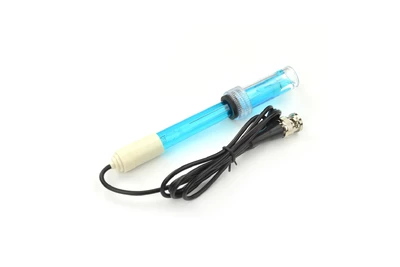
- Probe Maintenance / Hardware Upgrade: Choose the Industrial pH Electrode - Armor Casing (FIT0348). This is an industrial-grade bare electrode equipped with a BNC connector and a 5-meter cable.
Detailed Product Categories & Technical Analysis
Category 1: Laboratory-grade Sensors (Suitable for short-term measurement, teaching demonstrations, and maker projects)
This series offers exceptional cost-performance and good measurement accuracy, meeting most routine testing needs. Note: Laboratory-grade probes are NOT suitable for long-term underwater continuous monitoring. After use, they must be cleaned and properly stored in a protective solution.
Gravity: Lab Grade Analog pH Sensor Kit for Arduino / Raspberry Pi (with Calibration Solutions)
SKU: SEN0161-V2
- Product Advantages: Fully upgraded to a 3.3~5.5V wide voltage operating range, making it perfectly compatible with mainstream open-source hardware like Arduino, Raspberry Pi, and micro:bit. A built-in hardware filtering circuit ensures smoother and more stable signal output, while the software library supports the automatic identification of standard buffer solutions.
- Application Scenarios: Maker DIY projects, initial hydroponic environment testing, and college/university laboratory teaching.

Category 2: Industrial-grade Online Monitoring Sensors (Suitable for aquaculture, long-term automated equipment)
Utilizing a PTFE (Polytetrafluoroethylene) ring membrane and gel electrolyte, this series boasts excellent anti-pollution and anti-clogging properties, supporting 7/24 long-term underwater submersion.

Gravity: 7/24 Industrial Analog pH Meter Kit (Arduino, Raspberry Pi)
SKU: SEN0169-V2
- Product Advantages: Also upgraded with 3.3~5.5V wide voltage support and hardware filtering. Equipped with a 5-meter industrial cable, the probe features a design life of over half a year under normal water conditions.
- Application Scenarios: Long-term water quality monitoring for aquariums and fish tanks, automated dosing systems for smart agriculture/hydroponics, and wastewater treatment process monitoring.

- Product Advantages: Features a sharp stainless steel spear tip protection shield, allowing direct insertion into semi-solid materials like wet soil, fruits, vegetables, and meat for pH measurement.
- Precautions: Measurement range is 0-10 pH. It is strictly prohibited from measuring hard solids or samples containing sharp particles. The probe must be carefully cleaned after each test.
Category 3: Industrial IoT / Robust Bus Communication Integration
Designed specifically for mature industrial control systems, PLC equipment, or long-distance wireless transmission nodes (such as the DFRobot LoRaWAN ecosystem).

- Product Advantages: Adopts an integrated industrial-grade housing design, supporting RS485 interfaces and the standard Modbus-RTU protocol. It possesses strong anti-electromagnetic interference capabilities, making it ideal for long-distance transmission. A built-in temperature sensor provides Automatic Temperature Compensation (ATC). Supports a 10-30V DC wide voltage power supply and features an IP68 waterproof rating.
- Application Scenarios: Industrial field deployment, large-scale smart agriculture IoT nodes, commercial aquaculture, and wastewater treatment plants.
Category 4: Replacement Accessories & Consumables

- Product Description: This product is solely an independent electrode probe equipped with a 5-meter cable and a standard BNC connector. It does not include a signal conversion board.
- Application Scenarios: Suitable for users who already own Gravity: Lab Grade Analog pH Sensor Kit for Arduino (SKU: SEN0161) or Gravity: 7/24 Industrial Analog pH Meter Kit for Arduino (SKU: SEN0169) series signal boards and need to replace an aging probe, or users looking to upgrade an existing laboratory project to an industrial-grade probe.
3. Core Parameters Comparison Table
Product Name
Gravity: Lab Grade Analog pH Sensor Kit for Arduino / Raspberry Pi (with Calibration Solutions)
Gravity: 7/24 Industrial Analog pH Meter Kit (Arduino, Raspberry Pi)
Figure


SKU
SEN0161
SEN0161-V2
SEN0169
SEN0169-V2
SEN0708
Signal Output
Analog Voltage
Analog Voltage
Analog Voltage
Analog Voltage
Digital Comm (RS485 Modbus)
pH Range
0~14 pH
0~14 pH
0~14 pH
0~14 pH
0~14 pH
Operating Voltage
5.0V
3.3~5.5V
5.0V
3.3~5.5V
10~30V DC
Accuracy
±0.1 pH
±0.1 pH
±0.1 pH
±0.1 pH
±0.15 pH (Includes ATC)
Long-term Submersion
❌ No (Not supported)
❌ No (Not supported)
✅ Yes (7/24 support)
✅ Yes (7/24 support)
✅ Yes (IP68 Waterproof)
Cable Length
~100cm
~100cm
500cm
500cm
500cm
Typical Target
Routine water sampling
Routine water sampling
Long-term monitoring of general water, weak acid/base
Long-term monitoring of general water, weak acid/base
Complex industrial wastewater, large-scale agricultural water
Add to Cart
Add to Cart
Add to Cart
Add to Cart
Add to Cart
Add to Cart
4. Selection & Usage Precautions
To ensure the accuracy of your measurement data and prolong the sensor's lifespan, please pay attention to the following points during selection and usage:
- Match the probe grade to your application scenario: The glass membrane of laboratory-grade probes (like the Gravity Analog pH Sensor SEN0161 series) is prone to aging under continuous, long-term submersion, leading to severe data drift. If your project requires continuous underwater monitoring for months (e.g., smart aquariums, automated hydroponic systems), please choose an industrial-grade sensor (like the Gravity 7/24 Industrial Analog pH Meter SEN0169 series or RS485 Modbus pH Sensor SEN0708).
- Verify power supply voltage compatibility: If you are using a Raspberry Pi, ESP32, or a new-generation mainboard with 3.3V logic levels, it is highly recommended to select analog sensor models with the "V2" designation. They feature built-in wide-voltage regulator chips, perfectly supporting 3.3V power supplies and signal outputs without additional level shifters.
- Regarding white crystals around the probe cap: Upon receiving a new probe, you may notice a small amount of white powder crystallization around the protection cap. This is a normal physical phenomenon caused by the minor leakage and subsequent drying of the internal 3.3mol/L KCl protective solution during transit. It does not affect the lifespan or accuracy of the probe. Simply brush the crystals back into the cap, or add a suitable amount of pure water/KCl solution to keep the probe moist, and use it with confidence.
- The importance of temperature compensation: The pH value of a solution fluctuates with temperature. In high-end applications, the RS485 Modbus Water Quality pH Sensor (SEN0708) comes with built-in Automatic Temperature Compensation (ATC). For other analog models, if the water temperature in your measurement environment fluctuates significantly, it is highly recommended to add a dedicated water temperature sensor (such as the DS18B20) to your system and incorporate temperature compensation logic into your software algorithm to obtain more rigorous pH measurements.


Need an ORP sensor? We compare entry-level Arduino meters, 24/7 online probes, and IP68 industrial RS485 sensors to help you build the best water IoT system.
SELECTION GUIDE
This guide provides a side-by-side comparison and selection analysis for 5 core Electrical Conductivity (EC) sensors from DFRobot, helping you quickly identify the most suitable product based on measurement range (K-value), application scenario (industrial/laboratory), and system architecture (Analog/RS485).
SELECTION GUIDE
Discover how DFRobot’s hands-on workshop at Kathmandu University helps teachers bring AI into K–12 classrooms using project-based learning, voice interaction, and computer vision tools.
NEWS