
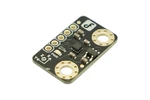
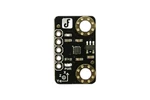


Fermion: BMA220 Digital Triaxial Acceleration Sensor (Breakout, ±16g)
- $4.80 2+ items
- $4.60 5+ items
- $4.20 10+ items


Introduction
Triple Axis Accelerometer with Bosch BMA220 is an ultra‑compact triaxial acceleration sensing module designed for low‑power motion detection applications. Based on Bosch’s miniature BMA220 MEMS chip, this compact motion sensing board measures acceleration across three perpendicular axes, enabling precise detection of tilt, orientation, shock, and vibration. The tiny breakout board communicates through an I2C interface and integrates easily with embedded controllers such as Arduino, making the sensor suitable for robotics, portable electronics, human‑machine interfaces, and interactive control systems where space efficiency and low energy consumption are essential.
Note: Recommend connecting the sensor to a 3.3V powered microcontroller. Direct operation is also possible with Arduino UNO or arduino Leonardo development boards (system working voltage: 5V).
Ultra‑Compact MEMS Motion Sensor
Bosch BMA220 technology enables a highly miniaturized motion detection solution measuring only 2 mm × 2 mm at the chip level. This triaxial acceleration sensing board provides reliable motion, tilt, and vibration sensing while maintaining an extremely small PCB footprint of 13 × 22 mm. Such compact dimensions make the module well suited for portable electronics, embedded robotics systems, wearable prototypes, and space‑constrained interactive devices where traditional accelerometer modules would be too large.
Flexible Motion Detection and Orientation Sensing
The three‑axis acceleration sensing module supports selectable measurement ranges of ±2g, ±4g, ±8g, and ±16g, allowing designers to adapt sensitivity for different motion environments. This flexibility enables accurate monitoring of orientation changes, gesture inputs, shock events, and vibration patterns. Applications include handheld controllers, gaming interfaces, menu navigation systems, and motion‑controlled electronics where precise detection of device movement enhances user interaction.
Low‑Power Interface for Embedded Systems
An energy‑efficient MEMS sensing architecture combined with an I2C communication interface allows easy integration with microcontroller platforms and embedded development boards. The low‑power acceleration detection module suits battery‑powered electronics and continuous motion monitoring systems. Integrated power indication and a straightforward pin header layout simplify wiring during rapid prototyping, experimental robotics development, and compact electronic product design.
Typical applications include motion‑aware consumer electronics, robotics control systems, virtual reality interaction devices, gaming controllers, handheld electronics, and experimental motion detection projects used in STEM Education environments and embedded system prototyping.
Features
- Bosch BMA220 MEMS triple‑axis accelerometer
- Selectable acceleration ranges: ±2g / ±4g / ±8g / ±16g
- I2C communication interface for microcontroller integration
- Ultra‑low power operation suitable for portable devices
- Compact breakout board design (13 × 22 mm)
- Integrated LED power indicator
- Compatible with Arduino controllers
- Suitable for tilt, motion, shock, and vibration detection
Applications
- Tilt and orientation detection systems
- Motion‑controlled gaming devices
- Human‑machine interface (HMI) control
- Portable electronics motion sensing
- Shock and vibration monitoring
- Robotics motion feedback systems
- Virtual reality interaction devices
Specification
- Power supply: 2.0-3.6V
- Interface: I2C
- Acceleration range: ±2g/±4g/±8g/±16g
- Ultra Low Power
- LED power indication
- Tiny size design and easy-to-use
- Compatible with Arduino controllers
- Size: 13x22mm(0.51x0.87")
Shipping List
- Triple Axis Accelerometer BMA220 (Tiny) x1
- 5P Pin Headers x1